
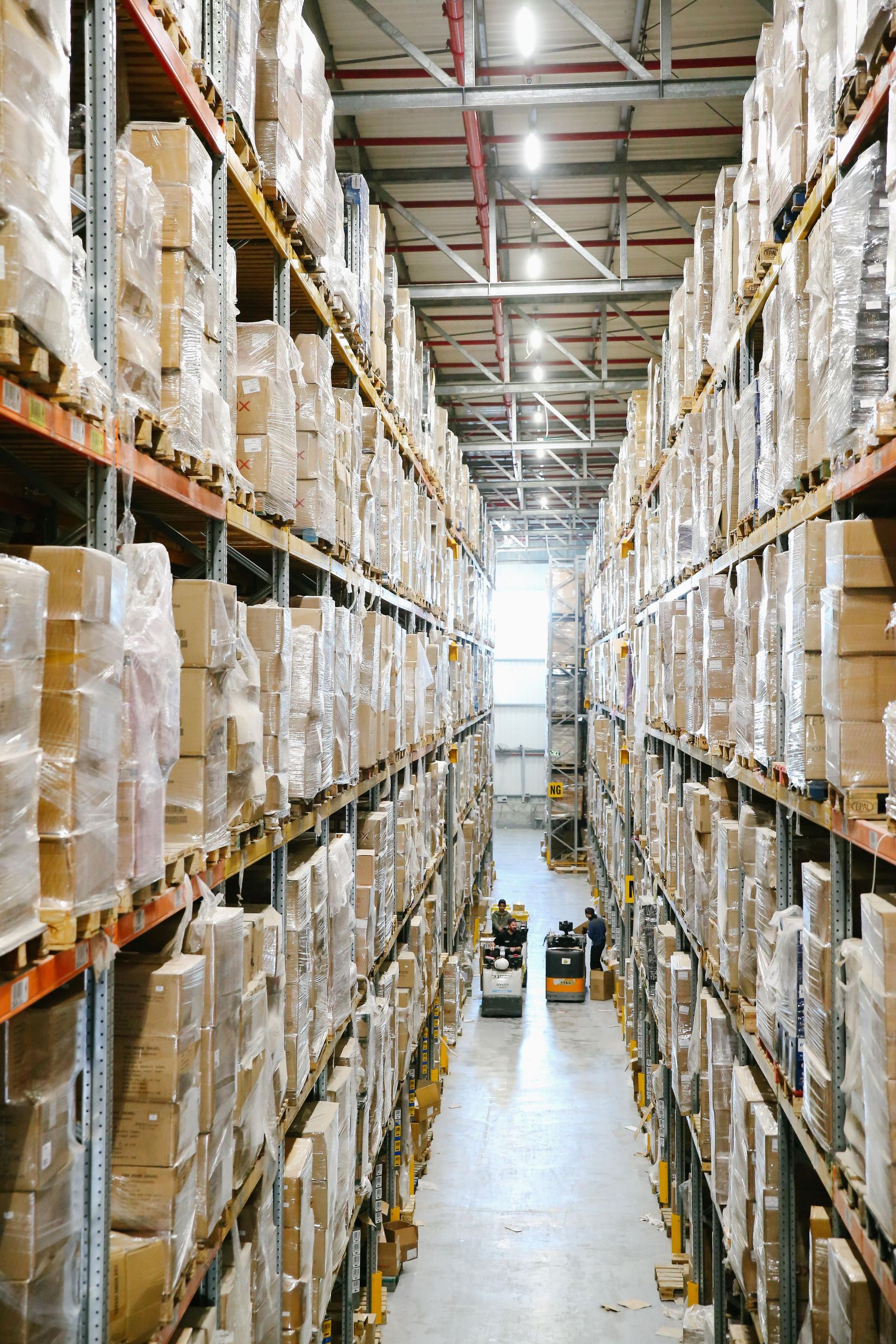
Push-back racking.
+90% density vs selective. 2-6 pallets deep. LIFO flow. Single-aisle access — same forklift, same aisles, dramatically more storage cube.
Density when SKUs are bulk-stored.
Because density wins when SKUs are bulk-stored. +90% storage cube vs selective, single-aisle forklift access, ideal for same-SKU operations that don't need FIFO strict rotation.
Pallets load onto nested carts that ride inclined rails. The newest pallet pushes the others back; picking the front pallet lets the rest gravity-flow forward to the pick face. Same forklift, same aisles — you simply store 2 to 6 pallets in the depth of one selective bay.
The components, labeled.
Five parts do the work in a push-back lane. Same structural uprights as selective — the inclined rails and nested carts are what turn one pick face into a lane 2–6 pallets deep.
Upright Frame
Structural frames at the front and rear of the lane carry the inclined rails. The pick face sits on the aisle; the lane extends back from it.
Nested Cart (Lower)
The wider lower cart rides directly on the inclined rails. Carts nest one above the other, so each deeper pallet sits slightly higher than the one in front.
Nested Cart (Upper)
The narrower upper cart nests above the lower one and carries the rearmost pallet. Each new pallet loaded at the pick face pushes the stack one position deeper.
Front Pallet on Rails
The lead pallet sits directly on the rails at the pick face — not on a cart. Picking it releases the lane, and the carts behind roll forward to present the next pallet.
Inclined Rail
The rail pair pitches gently down toward the aisle — roughly 4 degrees. Gravity does the work: loading pushes the lane back, picking lets it roll forward.
Full technical detail.
Engineered to your bays, by lane depth. Every lane is load-rated to CSA A344-17 + ANSI MH16.1; engineer-stamped drawings available on request.
| Specification | 2-Deep | 4-Deep | 6-Deep |
|---|---|---|---|
| Lane Configuration | |||
| Pallets deep | 2-deep | 4-deep | 6-deep |
| Density vs selective | +50% | +75% | +90% |
| Throughput cycles | LIFO | LIFO | LIFO |
| Pallet Capacity | |||
| Per pallet | 2,500 lb | 2,500 lb | 2,500 lb |
| Per lane (cart total) | 5,000 lb | 10,000 lb | 15,000 lb |
| Rail & Frame | |||
| Rail profile | Galvanized C-channel | Galvanized C-channel | Heavy-duty C-channel |
| Rail slope | 3° | 3.5° | 4° |
| Frame depth | Lane-depth + 12" | Lane-depth + 12" | Lane-depth + 16" |
| Finish & Compliance | |||
| Finish | Powder-coat | Powder-coat | Powder-coat or galvanized |
| CSA A344-17 aligned | ✓ | ✓ | ✓ |
| ANSI MH16.1 (RMI) aligned | ✓ | ✓ | ✓ |
| Operations | |||
| Lead time | 5-7 business days | 10-14 business days | 3-4 weeks |
| Install crew size | 3-4 | 3-4 | 4-5 |
| Best for | Mid-velocity SKUs | Bulk same-SKU storage | Cold storage + 3PL |
Push-Back Racking — engineered to your spec
Send your warehouse dimensions + SKU profile + throughput target. We'll come back with an engineered layout + itemized quote within 5 business days. Engineer-stamped drawings available on request.
Where push-back racking wins.
Bulk same-SKU storage
When you store many pallets of one SKU at a time. Push-back gives you 4-6 pallets in the depth of one selective bay.
Cube savings on HVAC
Compresses pallet positions into less square footage — major HVAC savings. Common in -20°C freezer + 2°C cooler operations.
Predictable replenishment
When you store inventory for clients with predictable replenishment cycles. Maximizes cube without sacrificing single-aisle pick access.
Push-back vs. the alternatives.
Density + pick speed
2-6 deep, LIFO, single-aisle access. Faster to pick than drive-in — you stay in the aisle.
You're hereMaximum density
Few SKUs, deep volume, LIFO. Lowest cost per position — the forklift drives into the lane.
View product →FIFO alternative
Same high density as push-back, but first-in-first-out rotation. The call when stock dating matters.
View product →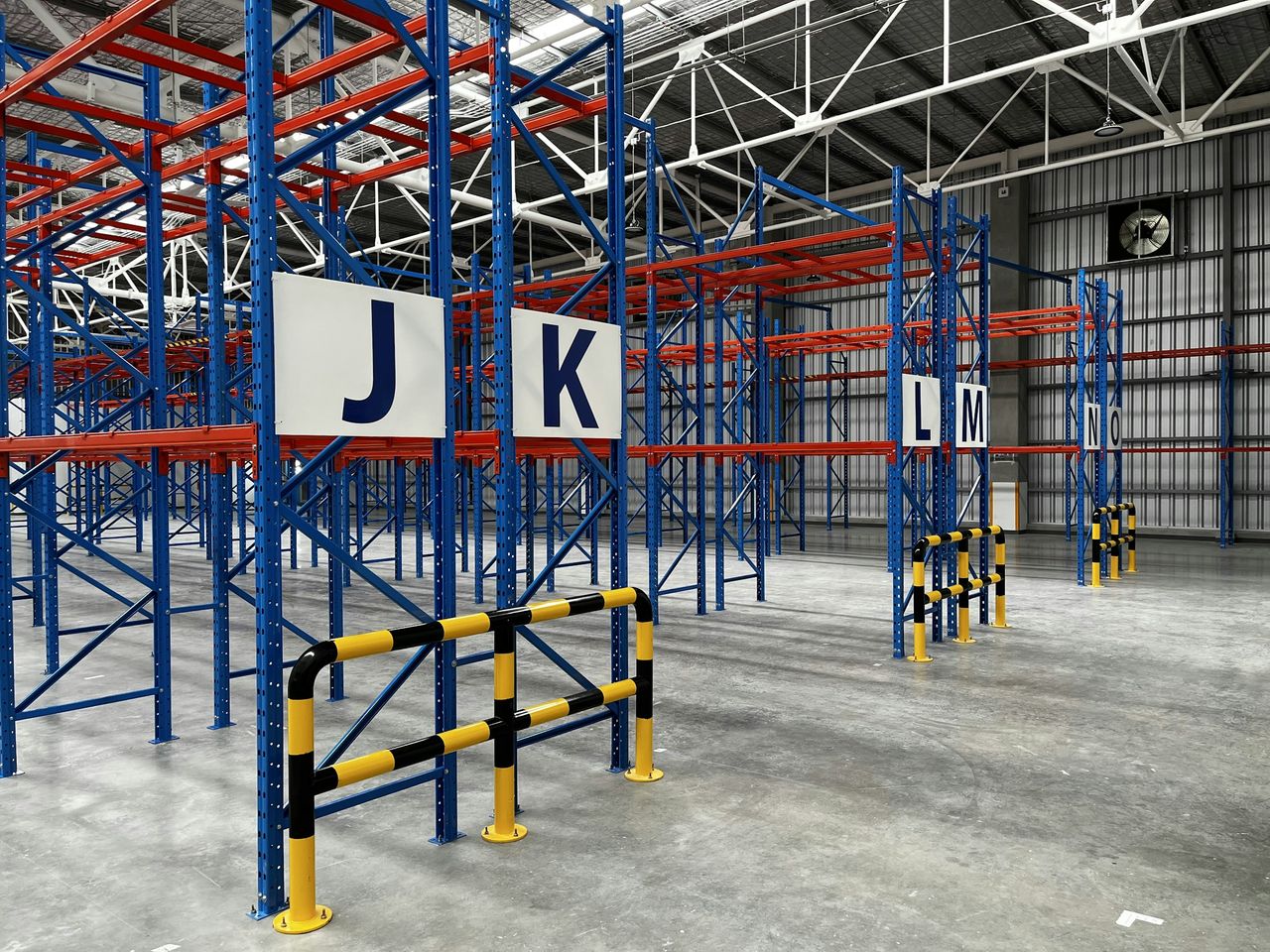 STOCK · racking aisles with floor markings · real 416 job photos rolling out
Where push-back earns its keep.
Same-SKU operations that store deep and pick from a single aisle. Cold storage where every cooled cubic foot is expensive. 3PL and bulk distribution with predictable replenishment. If your stock doesn't need strict FIFO rotation, push-back packs 2-6 pallets into the footprint of one selective position — without giving up your existing forklift or aisle layout.
Build your push-back layout. Get a ballpark in 60 seconds.
Pick your space, racking + add-ons and watch it build itself. Instant ballpark, no obligation — same-day reply from the in-house crew.
60 seconds · no obligation · across the GTA · (647) 692-4416