
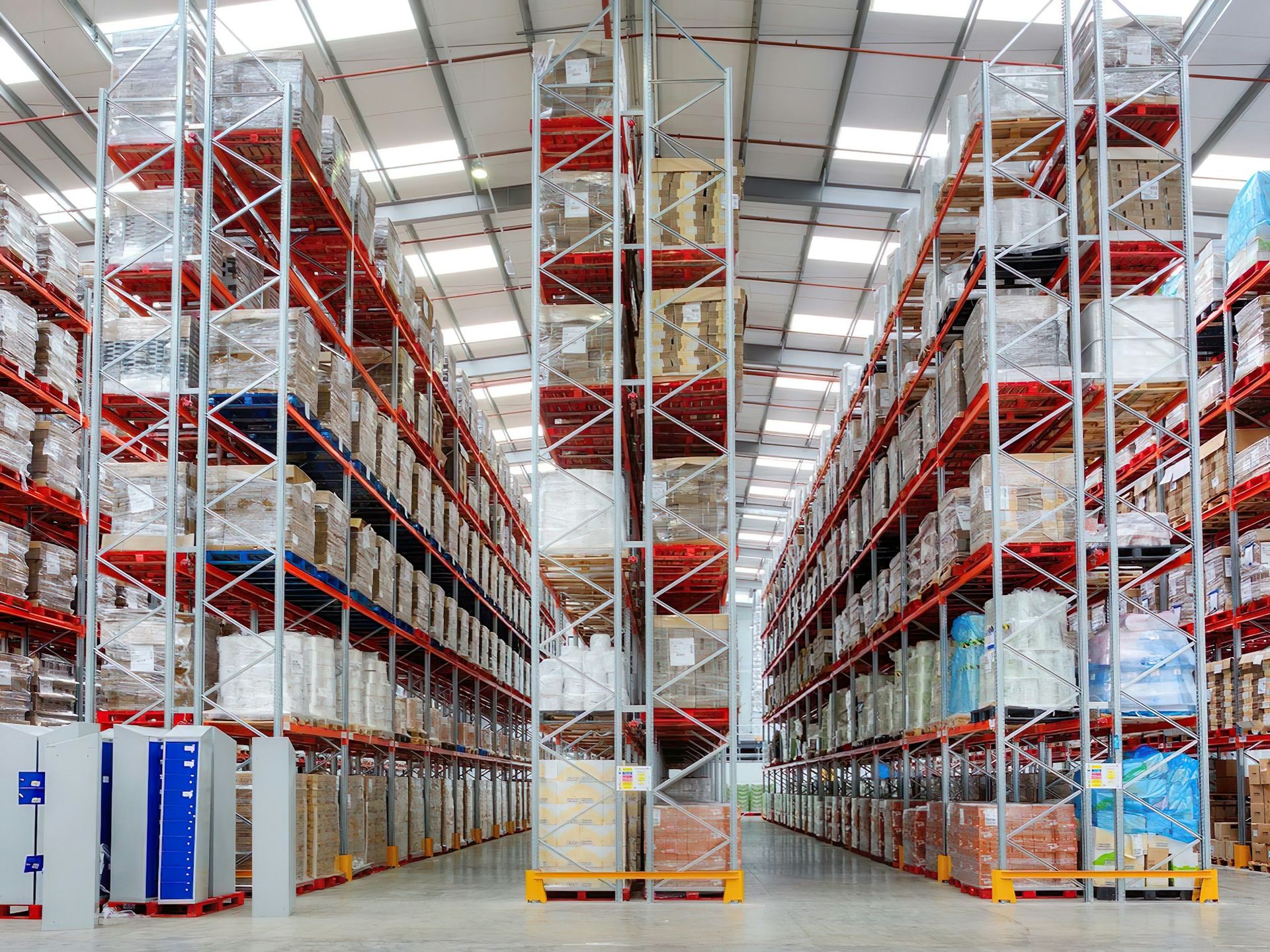
Understanding load capacity: beams, uprights, and safety margins.
Beam pair capacity, upright frame capacity, and how to read the racking load chart — plus how to spot mis-rated installs before they fail.
The three numbers that keep a warehouse standing.
When designing or retrofitting a warehouse, industrial facility, or distribution center, understanding load capacity is non-negotiable. Overloading racking systems can result in catastrophic failure, injury, and operational shutdown. Yet many facility managers struggle to decode the three critical numbers that determine safe storage: beam pair capacity, upright frame capacity, and overall system/bay capacity.
This guide walks you through each metric, how to read capacity plaques, the engineering factors that affect load limits, and the practical calculations you need to keep your operation safe and efficient.
The three critical load capacity numbers.
Industrial racking systems are engineered with three overlapping capacity limits. Understanding the relationship between them is essential—your actual safe load is the smallest of these three numbers.
1. Beam pair capacity (per level)
This is the weight a single horizontal beam level can support when fully loaded across its entire span. For example, a standard 8-foot beam pair in a selective racking system might have a capacity of 5,000 lbs. This number assumes the load is evenly distributed along the beam's length and that the beams are properly seated in their connections.
Beam pair capacity depends on several factors:
- Beam profile and material grade: Deeper, heavier beams support more weight. Grade 50 steel beams support more than Grade 36.
- Beam length: Longer beams have lower capacity because they deflect more under load. A 10-foot beam pair typically supports less than an 8-foot pair.
- Connection type: The strength of the beam-to-upright connection matters. Welded connections are stronger than bolted ones, though properly torqued bolts perform well.
- Load distribution: Uniform loads (evenly spread pallets) allow higher capacity than point loads (heavy concentrated items).
You'll find the beam pair capacity clearly labeled on a placard attached to the racking system or in the manufacturer's technical documentation. Always verify this number before stacking goods.
2. Upright frame capacity (vertical load path)
The upright frame is the vertical backbone of the racking system. While beam pair capacity tells you what one level can hold, upright frame capacity tells you the total load the entire vertical structure can support across all levels combined.
For example, if you have a 4-level selective racking unit with a 5,000 lbs beam pair capacity per level, the total load across all four levels combined cannot exceed the upright frame capacity—which might be 18,000 lbs. This accounts for how force distributes downward through the vertical posts to the floor, and the buckling resistance of the uprights.
Upright frame capacity is affected by:
- Upright profile: Stronger, thicker-walled uprights support more total weight.
- Frame height: Taller frames have lower capacity because they're more prone to buckling under load.
- Base design: Uprights must be properly anchored to the floor. Bolt-down vs. welded-on bases affect the total safe load.
- Diagonal bracing: Cross-bracing strengthens the frame against side loads and buckling.
3. Overall system/bay capacity (configuration limit)
This is the practical maximum load your entire racking configuration can safely handle given the floor's load-bearing capacity, the specific arrangement of levels, and any local or regional building codes.
For instance, even if your beams can hold 5,000 lbs per level and your uprights can support 18,000 lbs, local regulations might impose a 10,000 lbs maximum for the entire system, or your concrete floor might not support the concentrated load. The system capacity is the lowest limiting factor.
This figure accounts for:
- Floor load rating and bearing capacity
- Local safety codes and standards (ANSI, CSA, IBC)
- Seismic considerations (if in earthquake zones)
- Wind load requirements for outdoor systems
The golden rule
Your safe load is ALWAYS the lowest of these three numbers. Never exceed any one of them, even if the others have capacity remaining. When in doubt, contact your racking manufacturer or a structural engineer.
Reading capacity plaques and documentation.
Racking systems manufactured to modern standards have capacity information displayed on a placard. This placard is required by safety standards and should be prominently mounted on the racking.
A typical capacity placard shows:
- Manufacturer name and system model
- Date of manufacture
- Beam pair capacity (often shown as "per pair per level" and sometimes in both lbs and kg)
- Maximum number of levels and total system capacity
- Load distribution assumptions (uniform vs. point load)
- QR code or document reference linking to engineering drawings
If your racking system is older or the placard is missing, do not guess. Request technical documentation from the manufacturer or hire a structural engineer to assess capacity. Assumptions about load limits can be fatal.
Uniform distributed load vs. point loads.
How you arrange goods dramatically affects safe capacity. The distinction between uniform distributed loads (UDL) and point loads is critical.
Uniform Distributed Load (UDL): Weight spread evenly across the beam's entire length. Example: Three pallets of equal weight positioned across an 8-foot beam pair. A beam rated for 5,000 lbs UDL can safely hold three 1,500-lb pallets spread across its length.
Point Load: Heavy weight concentrated in a small area. Example: One 4,000-lb industrial machine centered on a beam. Point loads create higher stress at the connection points and are more likely to cause beam deflection and deformation.
Most manufacturers provide capacity ratings for UDL scenarios. If you need to store point loads, your safe capacity may be significantly lower—sometimes 50-70% of the rated UDL capacity, depending on how concentrated the load is.
“A point load of 3,000 lbs on a single pallet may exceed the safe point load capacity of a beam rated for 5,000 lbs UDL. Always clarify with your manufacturer whether your goods meet UDL assumptions.”
Safety factors and engineering standards.
Industrial racking systems are designed with a safety factor—a multiplier that ensures the system can handle its rated capacity plus additional stress from impacts, vibrations, and unforeseen circumstances.
The typical safety factor for steel storage racking is 1.67x, meaning the system's actual structural strength is 67% greater than its rated capacity. This is mandated by standards like ANSI MH16.1 (RMI) and CSA A344-17.
For example, if a beam is rated for 5,000 lbs, the actual yield strength of the steel is approximately 8,350 lbs. The 1.67x safety factor accounts for:
- Material variability and manufacturing tolerances
- Fatigue from repeated loading cycles
- Dynamic impact loads during pallet placement and removal
- Uncertainty in load distribution
- Corrosion and wear over time
This is why exceeding rated capacity is so dangerous—you're not just using the safety factor, you're eroding it. Load a beam to 110% of its rated capacity and you've reduced the safety factor from 1.67x to 1.5x. At 150% capacity, the safety factor is nearly zero, and structural failure becomes likely.
How beam length affects capacity.
Longer beams hold less weight. This relationship isn't linear—it's governed by deflection mechanics.
As beams get longer, they bend more under load. The bending stress increases with the cube of the length (technically, the bending moment equals load × length / 4). This means a 12-foot beam doesn't just hold less than a 10-foot beam—it holds significantly less.
Typical capacity reductions with length:
- 8-foot beam: 5,000 lbs (baseline)
- 10-foot beam: ~4,000 lbs (20% reduction)
- 12-foot beam: ~3,100 lbs (38% reduction)
These are approximate—exact numbers depend on beam profile—but the pattern is clear. If you're designing a system for longer spans, expect either heavier-duty beams or lower density storage.
The role of cross-bracing.
Cross-bracing (diagonal members connecting uprights) serves two purposes: it increases the overall stiffness of the frame and it helps distribute loads more evenly. Bracing prevents the frame from swaying and stabilizes the system against lateral forces.
Systems with robust cross-bracing can safely support higher loads because:
- Lateral deflection is reduced, lowering stress on beam connections
- Buckling resistance of uprights improves
- The frame acts more rigidly, reducing dynamic movement
For high-rise systems (6+ levels) or systems storing heavy or dynamic loads, adequate bracing is essential. Older systems without sufficient bracing may need reinforcement before being loaded to modern capacity ratings.
When to call a structural engineer.
You should engage a structural engineer if:
- Capacity documentation is missing or unclear. Older systems, salvaged racking, or equipment from unknown manufacturers require professional assessment.
- You're modifying the system. Adding levels, changing beam length, or retrofitting requires engineering review to ensure the uprights and bracing can handle the new configuration.
- Your loads are unusual. Point loads, dynamic loads (vibration from machinery), or irregular weight distribution need engineering analysis.
- The floor condition is questionable. Cracked concrete, uneven surfaces, or moisture damage affect the bearing capacity and should be assessed.
- You're using the space for something different than originally designed. A system designed for light, stable goods may not be adequate for heavy machinery or volatile inventory.
- Visible damage or deformation exists. Bent uprights, cracked welds, or sagging beams indicate structural compromise requiring expert evaluation.
A structural engineer will charge $1,500–$5,000 for a capacity assessment, but it's far cheaper than dealing with a system failure, injuries, or litigation.
Practical calculation example.
Scenario: Can you store 15 pallets of heavy parts?
Given:
• Racking system: 4-level selective racking, 8-foot beam pairs
• Beam pair capacity: 5,000 lbs per level (UDL)
• Upright frame capacity: 18,000 lbs total
• System capacity: 16,000 lbs (floor limit)
• Your pallets: 15 pallets × 800 lbs each = 12,000 lbs total
Distribution plan:
• Level 1: 4 pallets = 3,200 lbs
• Level 2: 4 pallets = 3,200 lbs
• Level 3: 4 pallets = 3,200 lbs
• Level 4: 3 pallets = 2,400 lbs
Analysis:
PASS — Each level holds 3,200 lbs < 5,000 lbs beam limit
PASS — Total load 12,000 lbs < 18,000 lbs frame limit
PASS — Total load 12,000 lbs < 16,000 lbs system limit
Result: YES, this storage plan is safe.
Common overloading mistakes.
Years of warehouse consulting reveal patterns in how facilities exceed capacity:
Mistake 1: Assuming all pallets weigh the same. An 800-lb pallet mixed with a 1,500-lb pallet creates uneven distribution. The heavier pallet may exceed point load limits while the lighter one leaves capacity "unused."
Mistake 2: Forgetting the weight of the pallet itself. A standard wooden pallet weighs 40–50 lbs. A steel pallet weighs 100+ lbs. When calculating load, include the pallet weight, not just the goods.
Mistake 3: Stacking goods higher than the racking was designed for. A system designed for 4 levels is not safe at 5 levels, even if floor space permits. Uprights weren't engineered for that height.
Mistake 4: Placing heavy items on upper levels. Although counterintuitive to some, heavy loads should be stored lower. Upper levels are designed for lighter goods. Inverting this risks beam failure and instability.
Mistake 5: Not accounting for settling and impact loads. When a pallet is dropped onto a beam, the instantaneous force is much higher than the static weight. This dynamic load can exceed rated capacity even if the static weight is acceptable.
Mistake 6: Mixing compatible and incompatible systems. Bolting beams from one manufacturer onto uprights from another without engineering verification creates unknowns about connection strength.
Key takeaways.
- Always identify and respect three capacity limits: beam pair capacity, upright frame capacity, and overall system capacity
- Your safe load is the smallest of these three numbers
- Read capacity plaques carefully and understand whether ratings apply to uniform or point loads
- Beam capacity decreases significantly with length—a 12-foot beam holds substantially less than an 8-foot beam
- The standard safety factor (1.67x) erodes quickly if you exceed rated capacity
- Hire a structural engineer for systems with missing documentation, unusual loads, or planned modifications
- Heavy items belong on lower levels; upper levels are designed for lighter goods
- Account for pallet weight, impact loads, and dynamic stresses—don't just count product weight
Final thoughts.
Load capacity isn't abstract engineering—it's the difference between a safe, productive warehouse and a disaster waiting to happen. The placard on your racking system reflects careful structural analysis by qualified engineers. Respect it.
If you're unsure about your system's capacity, the cost of clarity is negligible compared to the cost of failure. Reach out to your racking provider, your engineer, or consult with 416 Industrial. We've helped hundreds of facilities verify, optimize, and upgrade their storage systems for safety and efficiency.
Need help? We’ll review your load capacity.
Our racking specialists can review your system's load capacity and help you maximize storage safely.
60 seconds · no obligation · across the GTA · (647) 692-4416