
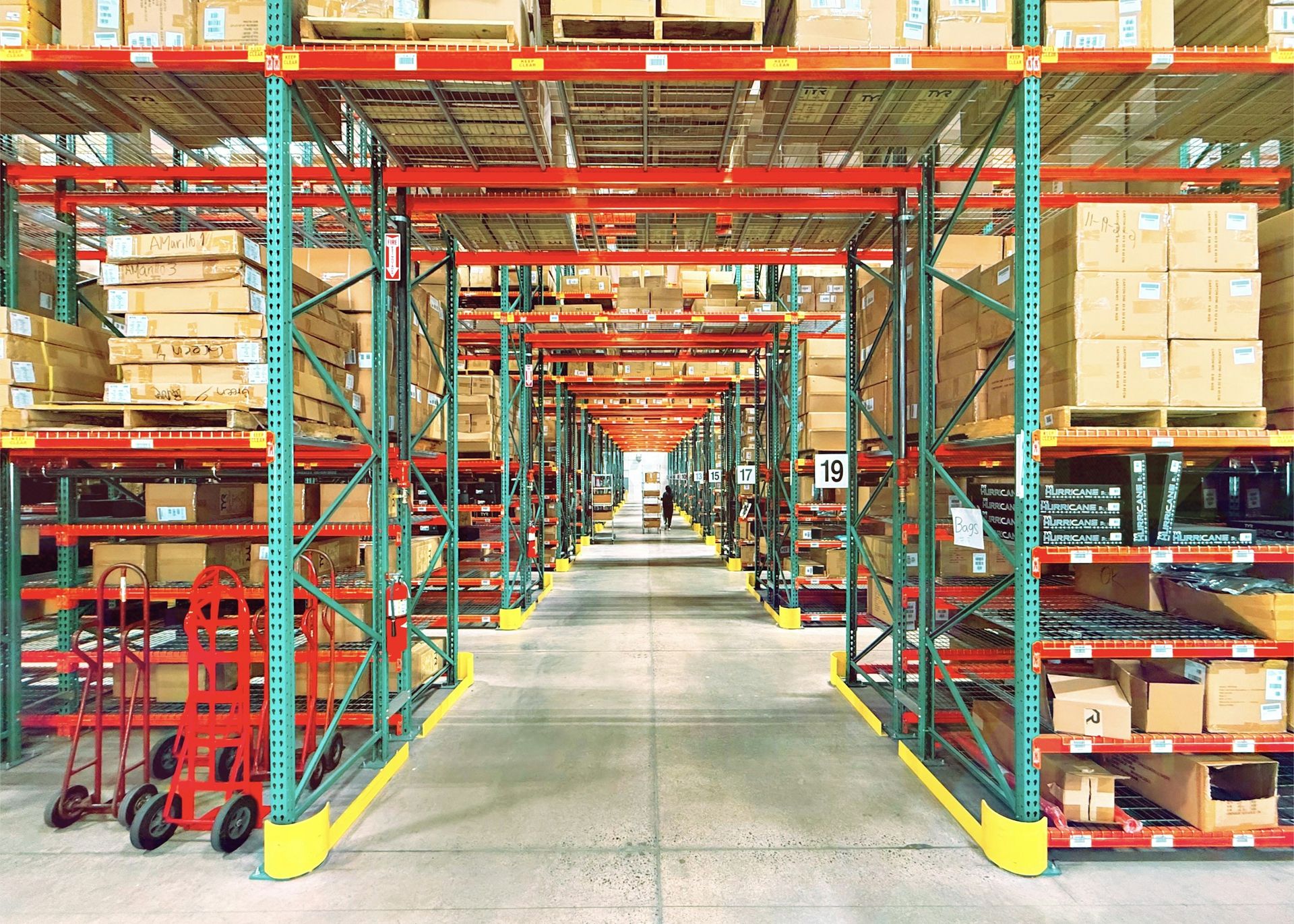
Selective vs. structural racking: which is right for your warehouse?
Two systems dominate the warehouse: roll-formed selective and bolted structural. They store pallets differently — in cost, capacity, density, and durability. Here is how to choose.
The decision that shapes the whole build.
When designing or redesigning a warehouse, one of the most critical decisions you'll make is selecting the right pallet racking system. Two primary options dominate the market: selective racking and structural racking. While both accomplish the basic goal of storing pallets vertically, they differ fundamentally in design, cost, capacity, and application. Understanding these differences will help you make an informed decision that maximizes space utilization, operational efficiency, and long-term value for your business.
Understanding selective racking (roll-formed / teardrop).
Selective racking, also called roll-formed or teardrop racking, is the most common warehouse storage system worldwide. It's the industry standard for general-purpose warehousing because of its versatility, affordability, and ease of use.
How selective racking works
Selective racking uses roll-formed uprights (vertical supports) that feature teardrop-shaped or slot-shaped openings. Horizontal beams with pronged load arms insert directly into these slots without tools or fasteners. This design allows operators to quickly access any pallet in the system—you can place a load at the front of any lane without moving others. The simplicity of this system is its greatest strength.
The uprights are typically manufactured from cold-rolled steel, while beams are usually welded steel with adjustable load arms. Load capacities range from 2,000 to 5,000 pounds per side (4,000 to 10,000 pounds per beam level) depending on span length and material grade.
Selective racking pros and cons
- Direct access to every pallet—no staging area needed
- Fastest picking and placement speeds
- Lowest initial capital cost
- Simple installation with minimal tools
- Easy to add or reconfigure as needs change
- Compatible with standard forklifts and reach trucks
- Wide variety of heights and configurations available
- Lower skill requirement for installers
- Moderate space efficiency (65-75% utilization)
- Load capacity limited by span length
- Vulnerable to forklift impact damage
- Aisle space reduces overall storage density
- More components to maintain and replace
- Less suitable for very high cube storage
- Higher inspection and maintenance costs
- Cannot accommodate extremely heavy loads
Understanding structural racking (bolted).
Structural racking, also called bolted racking, represents a fundamentally different approach to warehouse storage. Instead of pronged beams inserted into slots, structural racking uses bolted connections between uprights and beams. This creates a more rigid, integrated structure capable of supporting much heavier loads.
How structural racking works
Structural racking features welded box-section uprights (solid vertical columns) and structural steel beams that bolt directly to the uprights using gusset plates or end-plate connections. The bolted design creates essentially a rigid steel frame, with each level integrated as part of the overall structure. Load capacities are dramatically higher—often 10,000 to 50,000+ pounds per side, depending on design and material.
The rigidity of the bolted connection means the entire vertical structure acts as one unified unit. This allows for higher bay heights, larger span widths, and dramatically higher load densities than selective racking can support.
Structural racking pros and cons
- Exceptional load capacity (10,000-50,000+ lbs)
- Much higher space utilization (85-95%)
- Minimal aisle space requirements
- Extremely rigid—minimal deflection
- Ideal for very dense storage applications
- Superior durability under heavy use
- Better accommodates uneven loads
- Excellent for specialized applications (automation, cold storage)
- Significantly higher initial cost
- Complex and time-consuming installation
- Requires specialized installation equipment
- Difficult and expensive to reconfigure
- Requires custom engineering for modifications
- Takes longer to design and manufacture
- Specialized equipment often required for loading
- Cannot be modified by facility without engineers
Cost comparison: initial investment and lifecycle.
Cost is often the determining factor in choosing between these systems. Let's break down the numbers:
Selective racking costs
- Per unit basis: $80-$150 per pallet position installed
- 10,000 pallet position system: $800,000-$1.5 million
- Installation: 4-6 weeks, minimal specialized labor
- Annual maintenance: $20,000-$40,000 (inspections, repairs, component replacement)
Structural racking costs
- Per unit basis: $200-$400 per pallet position installed
- 10,000 pallet position system: $2-$4 million
- Installation: 8-12 weeks, specialized structural installation crew
- Annual maintenance: $15,000-$25,000 (less frequent component replacement, but more expensive parts)
While structural racking costs 2-3 times more per position, it provides significantly higher density storage. If your facility is space-constrained, structural racking's superior utilization may actually provide better cost-per-square-foot value when amortized over 10-15 years. For unlimited space, selective racking is more economical.
Load capacity: what your warehouse actually needs.
Load capacity significantly differs between systems, and this drives many implementation decisions.
Selective racking capacity
Standard selective racking typically handles 2,000-5,000 pounds per side (4,000-10,000 pounds per level). Capacity depends on:
- Span length: The distance between uprights. Longer spans reduce capacity significantly
- Height: Taller uprights may have lower capacity at higher levels
- Material grade: Heavier gauge steel increases capacity
- Load distribution: Concentrated loads vs. distributed loads
Most selective systems struggle with loads exceeding 5,000 pounds per side. If your operation involves heavier pallets—for example, steel coils, machinery parts, or dense materials—selective racking becomes impractical or unsafe.
Structural racking capacity
Structural racking easily handles 10,000-50,000+ pounds per side, and can be engineered for even higher capacities. The bolted design's rigidity means:
- The entire frame shares load distribution
- Individual bays can handle concentrated loads safely
- Uneven weight distribution is better tolerated
- Heavy, irregular shapes can be accommodated
If your operation requires consistent heavy loads or irregular heavy items, structural racking is often not optional—it's a necessity for safe operation.
| Feature | Selective Racking | Structural Racking |
|---|---|---|
| Load Capacity (per side) | 2,000-5,000 lbs | 10,000-50,000+ lbs |
| Initial Cost (per position) | $80-$150 | $200-$400 |
| Space Utilization | 65-75% | 85-95% |
| Direct Pallet Access | Yes (all pallets) | No (lane-based) |
| Installation Time | 4-6 weeks | 8-12 weeks |
| Reconfiguration Difficulty | Easy | Requires engineering |
| Deflection/Sag | Moderate (L/180) | Minimal (L/300+) |
| Impact Resistance | Moderate vulnerability | Much more robust |
| Annual Maintenance Cost | $20,000-$40,000 | $15,000-$25,000 |
| Suitable for Cold Storage | Yes | Superior |
Durability and impact resistance.
Warehouse operations involve forklifts, pallet jacks, and occasional accidents. How well does each system handle impact?
Selective racking impact tolerance
The pronged connection system is vulnerable to impact damage. When a forklift hits an upright, the force is concentrated at the point of impact. Minor collisions cause dents; significant collisions can bend uprights or separate connections. The teardrop design, while clever, offers limited redundancy—damage to a single component affects load distribution of the entire bay.
Many facilities with selective racking employ protective barriers and speed controls to minimize impact. Even with precautions, impact damage is the leading cause of selective racking failure and capacity reduction.
Structural racking impact tolerance
Bolted structural systems are dramatically more robust. The rigid frame distributes impact forces across the entire structure. A collision that would destroy a selective upright may only dent a structural column. The bolted connections are engineered with safety factors that allow the frame to withstand significant damage before functional capacity is impaired.
In high-traffic areas, around dock areas, and in facilities with intensive equipment use, structural racking's superior impact resistance dramatically reduces maintenance costs and operational disruptions.
"In facilities using both selective and structural racking, we consistently see selective systems requiring 3-4 times more impact damage repairs. For high-traffic operations, structural racking's added durability often justifies its higher initial cost within 5-7 years through reduced maintenance alone."
When to choose each system.
- Space is abundant and cost is the primary concern
- Loads are consistent and under 5,000 pounds per side
- Your operation requires frequent SKU access and high picking velocity
- You need flexibility to reconfigure as your business evolves
- You're storing general merchandise or lighter items
- You have sufficient floor space available
- Budget is limited and capital investment must be minimized
- Installation timeline is critical (faster deployment)
- Space is limited and maximum density is essential
- Loads are consistently heavy (5,000+ pounds per side)
- Your operation involves bulk storage or staging rather than pick-and-place
- You require long-term stability (10+ year operation in current configuration)
- You're storing heavy materials (steel, machinery, chemicals)
- Durability and impact resistance are priorities
- You operate in cold storage or harsh environments
- You're planning automated or semi-automated handling systems
Cold storage, specialized applications and installation.
Cold storage and specialized applications
Cold storage facilities (freezers and coolers) present unique challenges. Temperature extremes cause material expansion and contraction cycles that stress connections over time. The bolted design of structural racking handles this thermal cycling better than selective systems. Additionally, structural racking's superior rigidity means less deflection and movement—critical in subfreezing environments where ice buildup can exacerbate movement issues.
For specialized applications like pharmaceutical storage (requiring specific load densities), hazardous material storage (requiring redundancy and safety factors), or preparation for automation, structural racking is typically the better choice despite higher cost.
Selective racking installation
Installation is straightforward: base plates bolt to the floor, uprights stack or bolt together, and beams insert with load arms. Most installers can complete a selective racking system with standard tools. Lead time is typically 4-6 weeks from order to operational system. If space constraints mean you need the system online quickly, selective racking wins.
Structural racking installation
Structural racking requires precise engineering and specialized installation crews. Tolerances are tighter, connections are bolted (not snapped together), and load testing may be required. Installation takes 8-12 weeks minimum, plus engineering review. If you need the system installed tomorrow, this isn't your option. But once in place, it's remarkably stable and long-lived.
Making your decision: key questions.
Use these questions to determine which system fits your operation:
- What is your typical load weight? Under 3,000 lbs → Selective. Over 5,000 lbs → Structural.
- How much floor space do you have? Abundant space → Selective. Limited/expensive space → Structural.
- How frequently do you need to reconfigure? Often → Selective. Rarely/never → Structural.
- What is your primary operation? Pick-and-place picking → Selective. Bulk storage/staging → Structural.
- How critical is impact resistance? Low traffic → Either. High traffic → Structural.
- What is your budget? Minimize capital investment → Selective. Capital available → Structural possible.
- How long will this system need to function? 5 years → Selective reasonable. 10+ years → Structural better value.
Key takeaways.
- Selective (teardrop) racking is ideal for direct pallet access, lighter loads, and budget-conscious operations—it dominates for general warehousing
- Structural (bolted) racking provides superior capacity, density, and durability for heavy loads and space-constrained operations
- Selective racking costs 50-60% less per position initially but handles only 2,000-5,000 lbs per side
- Structural racking costs 2-3x more but handles 10,000-50,000+ lbs and provides 85-95% space utilization vs. selective's 65-75%
- For high-impact or high-traffic facilities, structural racking's superior durability reduces maintenance costs significantly over time
- Cold storage, heavy materials, and automation-ready operations almost always require structural racking
- The best choice depends on your specific load weights, available space, operational model, and long-term strategy—there is no universal winner
Need help choosing the right system?
Our warehouse design specialists can evaluate your operation and recommend the optimal racking solution for your specific needs and budget.
60 seconds · no obligation · across the GTA · (647) 692-4416