
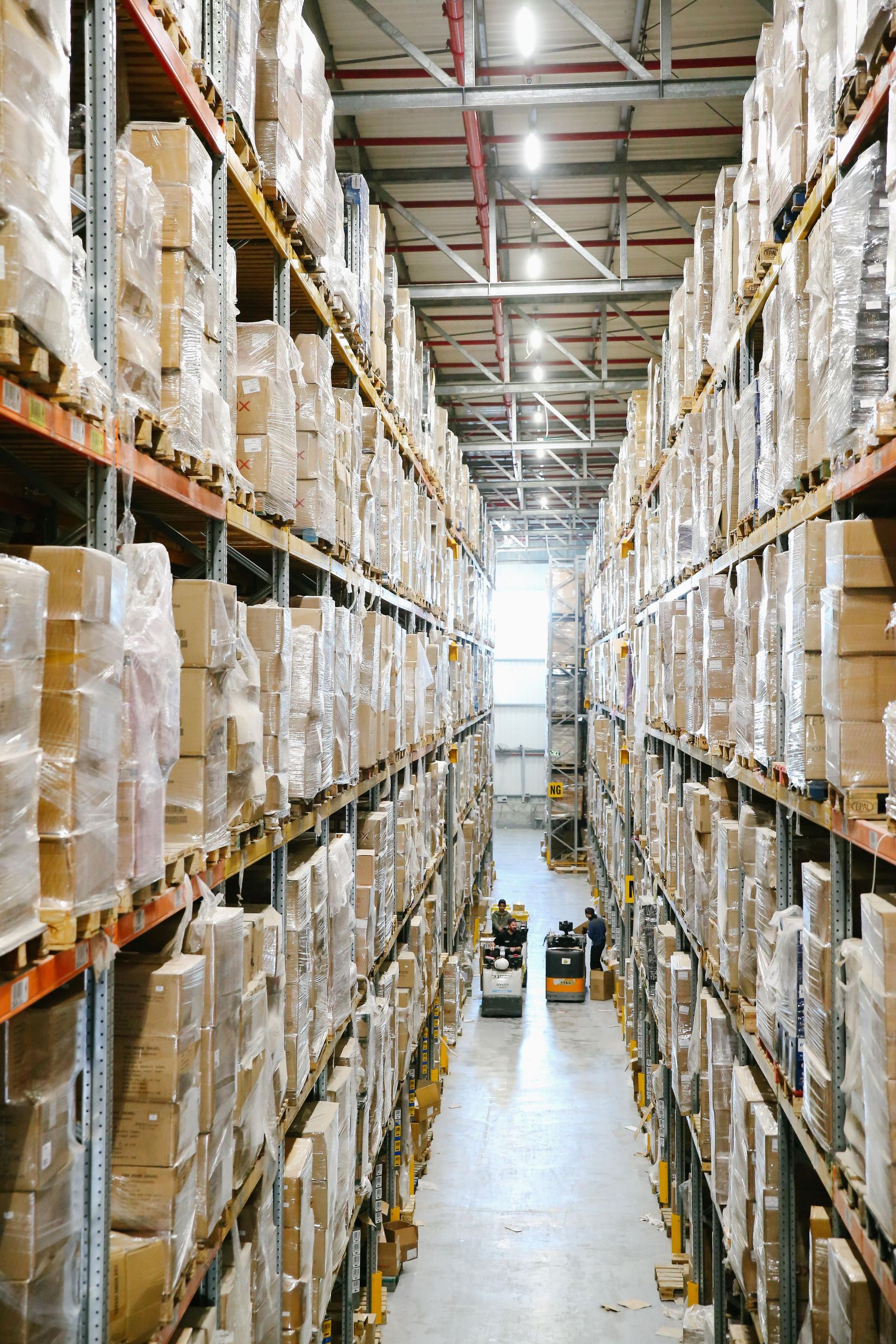
How to maximize warehouse storage density without expanding.
Proven strategies to increase warehouse storage density — selective racking, high-density systems, mezzanines, and VNA configurations explained. Gain 40–60% more capacity inside the footprint you already pay for.
Do more with the space you already have.
Real estate costs are rising, and warehouse expansion projects are becoming increasingly expensive and logistically complex. If your business is growing and you need more storage capacity, the good news is that expanding your physical facility might not be your only option. By implementing smart racking systems and warehouse optimization strategies, many companies can dramatically increase their storage capacity without building a single square foot of new space.
In fact, research from the Warehousing Education and Research Council (WERC) shows that facilities implementing high-density storage solutions can increase capacity by 40-60% within the same footprint. That's equivalent to gaining a massive facility expansion without the capital expenditure, construction timeline, or operational disruption.
Let's explore seven proven strategies that will help you maximize warehouse storage density and create room for growth.
The average warehouse operates at only 30-40% of its maximum potential storage density. By implementing just three of the strategies in this guide, most facilities can achieve 60-70% density improvement within 6-12 months.
Transition from selective to high-density racking
Selective racking—the most common system found in warehouses—is designed for accessibility. Every pallet has direct access via aisle, which makes it ideal for small inventory with high SKU counts. However, this accessibility comes at a significant cost to density.
Understanding the Density Trade-off
Selective racking typically achieves a storage density of 20-30 pallets per 1,000 square feet (depending on pallet size and aisle width). Compare this to high-density alternatives:
| Racking System | Pallets/1000 sq ft | Density Improvement | Application |
|---|---|---|---|
| Selective Racking | 20-30 | Baseline | High SKU count, frequent access |
| Drive-In Racking | 35-50 | +67% | Bulk storage, seasonal goods |
| Push-Back Racking | 45-60 | +100% | LIFO inventory, moderate SKU |
| Pallet Flow | 50-70 | +133% | FIFO inventory, high throughput |
| Double-Deep Selective | 40-50 | +75% | Moderate SKU, balanced access |
Choosing the Right System for Your Operation
Drive-In Racking: Forklifts drive directly into the rack structure to load and unload pallets. Ideal for bulk storage of products with low SKU counts. Best used in LIFO (Last-In-First-Out) operations where recent inventory is accessed first.
Push-Back Racking: Pallets sit on wheeled carriages that roll backward as new pallets are pushed in. Each lane operates as LIFO. This system balances density with moderate accessibility, supporting 5-10 different SKUs per lane.
Pallet Flow Racking: Uses gravity-fed rollers to automatically flow pallets forward as older ones are removed from the front. Operates as pure FIFO (First-In-First-Out), ensuring inventory rotation. Ideal for food, pharmaceuticals, and date-sensitive products.
A facility storing 500 pallets in selective racking across 16,000 sq ft could upgrade a 3,000 sq ft section to drive-in racking, storing 150+ pallets in that same space while freeing up additional selective racks elsewhere. Investment: ~$45K for new racking. Benefit: Equivalent to 500+ sq ft of additional capacity. Payback: 8-12 months through reduced real estate costs.
Add mezzanine platforms
Many warehouses have significant vertical space above ground-level operations that goes completely underutilized. Mezzanine platforms are structural platforms that create a second level of usable storage within a single-story facility.
Why Mezzanines Deliver Impressive ROI
A typical warehouse with 20-foot ceilings has nearly 50% of its vertical space above the reach of standard pallet racking (which tops out around 10-11 feet with accessible working height). By installing a mezzanine at the 12-15 foot level, you create an entire second floor without expanding your footprint.
Mezzanines can support 150+ psf (pounds per square foot), allowing them to hold selective racking, shelving, or pallet racks themselves. A 3,000 square foot mezzanine effectively doubles your usable storage area in that section.
Implementation Considerations
- Cost: $50-$150 per square foot installed (typically $150K-$450K for a 3,000 sq ft mezzanine)
- Timeline: 4-8 weeks installation, minimal facility downtime if phased correctly
- Capacity: Can increase storage capacity by 30-50% in affected areas
- Access: Requires stairs, ramps, or lift access; plan traffic flow carefully
- Compliance: May require building permits and structural engineering certification
Implement VNA (Very Narrow Aisle) systems
VNA (Very Narrow Aisle) racking reduces aisle widths to just 5-6 feet (compared to standard 8-12 foot aisles), allowing storage racks to be positioned more densely throughout the facility. This works because VNA-equipped forklifts use advanced steering and positioning technology to operate in tight spaces.
How VNA Systems Work
VNA forklifts feature:
- Articulating masts that rotate 90 degrees for loading/unloading without repositioning the truck
- Advanced steering systems (turret trucks) for precision placement in narrow aisles
- Guide rail systems (in some installations) that further enhance precision
- Operator training for the specialized skill set required
Density Impact and Trade-offs
By reducing aisle width from 10 feet to 6 feet, you can increase storage positions by approximately 30-40% in the same footprint. However, VNA systems have trade-offs:
- Higher equipment costs ($60K-$100K per VNA truck vs. $35K-$50K for standard counterbalanced fork trucks)
- Requires specialized operator training and certification
- Best suited for organized, systematic inventory management (not chaotic pile-and-retrieve operations)
- Reduced flexibility for emergency repositioning or quick changes
Average payback period: 2-3 years. A facility upgrading to VNA can achieve 35-40% capacity improvement with minimal facility modification, pure equipment upgrades. Initial investment is higher, but no construction is required.
Implement carton flow for optimized pick faces
Carton flow racking uses gravity-fed rollers to automatically advance cases to the pick face as inventory is depleted. This system is particularly valuable for distribution centers and fulfillment operations where cases are picked individually or in multiple cases per order.
How Carton Flow Increases Density
Traditional shelving requires a full-height pick face (all SKUs accessible without moving cartons). Carton flow allows you to store 4-6 rows of the same SKU behind the first pick face, dramatically increasing inventory without expanding floor area.
For example, instead of storing 4 cartons per SKU in traditional shelving, carton flow allows you to store 20-24 cartons of the same SKU in the same footprint, with automatic flow-forward. This is ideal for:
- Cross-dock and distribution operations
- E-commerce fulfillment centers
- Food and beverage distribution (especially FIFO-critical products)
- Any operation picking cases/cartons at high velocity
Implementation Considerations
Cost: $20-$40 per linear foot of carton flow. For a typical operation adding 500 linear feet: $10K-$20K investment.
Best For: Facilities with 50+ SKUs picking at high velocity. ROI is strongest when pick volume is 500+ picks per day.
Constraints: Inventory must be organized by SKU (requires strict put-away discipline) and carton weights must be uniform to prevent jams.
Maximize vertical space with higher uprights and multi-level racking
Many warehouses operate with racking systems that reach only 25-30 feet, leaving 10-20 feet of unused vertical space in the facility. Modern selective and high-density racking systems can reach 40+ feet with the right equipment and trained personnel.
Height Optimization Strategies
- Upgrade to taller uprights: 40-foot selective racking increases capacity per position by 33% versus 30-foot systems
- Add additional levels: Current 2-level racks can often be expanded to 3-4 levels with structural reinforcement
- Install higher-reach equipment: Advanced reach trucks and order pickers rated for 35+ feet enable safe access to upper levels
- Implement picking/restocking systems: Order picker lifts, man-up systems, and automated picking stations support efficient work at height
Safety and Operational Considerations
Higher racking requires:
- Equipment certified for greater heights
- Operator training and certification for height-rated equipment
- Regular inspection of all structural components
- Fall protection for workers accessing upper levels
- Sprinkler system clearance (check with fire marshal)
Optimize aisle layout and width calculations
The most underrated warehouse optimization technique is aisle reconfiguration. Many facilities inherit aisle layouts from previous operations and never revisit them. A comprehensive aisle width audit can unlock 10-15% additional capacity with zero capital expenditure.
Aisle Width Standards and Optimization
Standard aisle widths are based on equipment turning radius and safety margins. However, your current aisles may be wider than necessary:
- Counterbalanced forklifts: Minimum 10-11 feet (typical: 11-12 feet)
- Reach trucks: Minimum 9-10 feet (can operate in 8.5-foot aisles with precision)
- VNA forklifts: Minimum 6-7 feet
- Walkie stackers/order pickers: 6-8 feet depending on model
Optimization Approach
Conduct a full audit of your equipment fleet and current operating aisles. Many facilities can reduce main aisles by 6-12 inches and cross-aisles by 12-24 inches without sacrificing safety or operability. For a typical 30,000 sq ft facility, this optimization recovers 1,000-2,000 sq ft of additional storage.
Cost: Just engineering time and potential rack relocation ($5K-$15K for consulting and minor moves).
Integrate inventory management with warehouse layout
Even the best physical racking system loses efficiency if inventory is poorly managed. The optimal warehouse layout coordinates inventory characteristics with storage system selection.
Inventory-Driven Layout Planning
Fast-Moving SKUs: Position in selective racking closer to packing/shipping for rapid access. Consider carton flow for pick faces.
Seasonal or Bulk Inventory: Store in high-density drive-in or push-back systems at building perimeter. Access frequency is low, so density trumps accessibility.
Small Parts/High-SKU Count: Place in organized shelving with carton flow or organized bin systems near packing stations.
Raw Materials: Store in high-density systems near production input points. Integrate with production schedule for just-in-time delivery.
Warehouse Management System Integration
A robust WMS coordinates:
- SKU velocity analysis to determine optimal location strategy
- Put-away algorithms that position faster-moving items in more accessible locations
- Cycle counting routines that verify high-density inventory accuracy
- Slotting optimization that adapts placement seasonally
- Phase 1 (0-3 months): Audit current utilization. Implement aisle optimization and selective racking upgrades. Low-cost, quick wins. Expected gain: +10-15%
- Phase 2 (3-9 months): Deploy high-density systems (push-back, drive-in) in appropriate zones. Install carton flow for fast-moving inventory. Expected gain: +25-35%
- Phase 3 (9-18 months): Implement mezzanines and VNA systems if ROI justifies capital expenditure. Expected gain: +15-25%
- Ongoing: Continuous WMS optimization and inventory slotting adjustments yield +3-5% annual efficiency improvements
Sample implementation
Let's look at a typical scenario: a 40,000 sq ft warehouse storing 2,000 pallets (50 pallets per 1,000 sq ft—industry average for selective racking).
| Strategy | Investment | Pallets Added | Payback Period |
|---|---|---|---|
| Aisle optimization + selective upgrades | $15,000 | +300 | 3 months |
| Drive-in system (5,000 sq ft section) | $50,000 | +350 | 8 months |
| Push-back system (5,000 sq ft section) | $60,000 | +450 | 10 months |
| Mezzanine (5,000 sq ft) | $200,000 | +600 | 18 months |
| Total Implementation | $325,000 | +1,700 pallets (85% increase) | 12-16 months avg |
For a company paying $10/sq ft/year in lease costs, adding 1,700 pallet positions is equivalent to gaining 4,250 sq ft of capacity—a $42,500 annual lease savings. The entire multi-phase upgrade pays for itself in 8-9 years while providing 85% capacity growth.
Your action plan
Maximizing warehouse storage density isn't a single solution—it's a comprehensive strategy tailored to your specific inventory, facility, and operational characteristics. Here's how to proceed:
- Assess Current State: Conduct a detailed facility audit. Measure aisles, catalog current racking systems, analyze SKU velocity.
- Analyze Inventory: Use your WMS to identify fast vs. slow movers. Calculate storage requirements by category.
- Model Scenarios: Work with a racking specialist to design zone-specific solutions. Get cost estimates for each strategy.
- Prioritize by ROI: Implement quick wins first (aisle optimization), then progress to capital-intensive solutions (mezzanines).
- Integrate Systems: Ensure your WMS, material handling equipment, and safety protocols align with new racking configurations.
- Train and Optimize: Invest in operator training and continuous improvement. Monitor KPIs and adjust as needed.
The warehouse space you have today doesn't have to limit your growth tomorrow. By strategically implementing high-density storage solutions, you can expand capacity by 40-80% without expanding your physical footprint—saving millions in real estate costs while creating a more efficient operation.
416 Industrial specializes in designing and implementing comprehensive warehouse optimization solutions. Our team can assess your facility, identify opportunities, and guide you through implementation of the strategies that will deliver maximum ROI for your specific operation. Let's talk about how we can help your warehouse do more with what you already have.
Maximize your space
Get a free warehouse optimization assessment and discover your facility's untapped storage potential.
60 seconds · no obligation · across the GTA · (647) 692-4416