
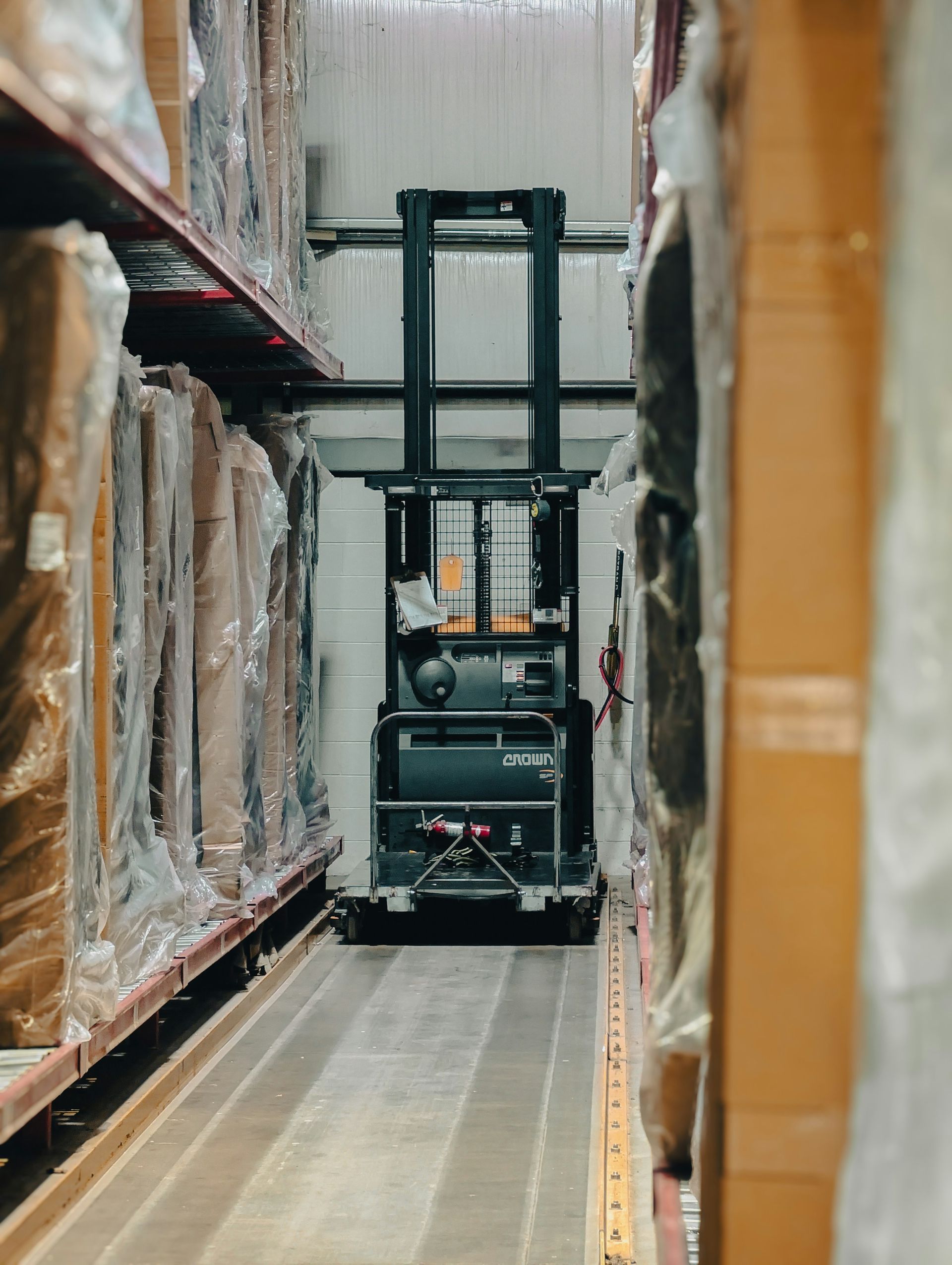
The rise of e-commerce fulfillment.
How 3PL and e-commerce fulfillment centers use selective, pallet flow, and push-back racking to handle high SKU velocity and same-day order picking.
From bulk storage to each-pick operations.
The warehousing landscape has transformed dramatically over the past decade. Where bulk storage once dominated, precision picking now reigns. E-commerce has fundamentally reshaped how third-party logistics (3PLs) and fulfillment centers operate, and their racking systems must evolve to match.
This shift isn't just about storing goods differently—it's about storing the right goods in the right places, accessible at the right speed. For 3PLs managing dozens of clients with varied inventory, seasonal peaks, and tight delivery windows, the wrong racking configuration can mean the difference between profitability and chaos.
Canada's logistics sector is booming. The Greater Toronto Area (GTA) alone hosts over 400 third-party warehousing operations, collectively managing billions in inventory for retailers, brands, and marketplaces. Yet many of these facilities are operating with legacy infrastructure designed for a different era. This article explores how modern racking solutions are enabling 3PLs to compete in the e-commerce fulfillment race.
From bulk storage to each-pick operations.
The traditional warehouse model was straightforward: receive pallets, store pallets, ship pallets. Efficiency meant minimizing handling and maximizing cubic space. Racking systems reflected this philosophy—deep, narrow shelving optimized for density and pallet throughput.
E-commerce inverted this model. Today's fulfillment centers receive bulk shipments but fulfill orders by the carton, by the eaches (individual items), sometimes by the unit. A single pallet arriving might need to be "broken down" into 50+ individual orders destined for different customers across the continent.
This shift demands:
- Visibility: Picking staff must quickly locate items within massive inventory. Vertical zoning and clear labeling became critical.
- Accessibility: Goods can't be locked behind three pallets deep. Items must be reachable within 2-3 steps.
- Velocity: Fast-moving SKUs need faster access paths. Slow movers can tolerate less-convenient storage.
- Flexibility: Inventory profiles shift seasonally and with trends. Racking must accommodate dynamic reconfiguration.
These demands make the old "stack high, reach low" approach insufficient. 3PLs need racking systems engineered for picking speed, ergonomic access, and rapid adaptation.
Why 3PLs need different racking configurations.
A 3PL warehouse isn't a single-client storage facility. It's a multi-tenant operation where inventory from dozens of clients coexists, each with different SKU velocities, seasonal patterns, and service requirements. This complexity makes racking selection uniquely challenging.
Consider the numbers: A 100,000 sq. ft. fulfillment center might house 50,000+ SKUs across 15+ different client accounts, with some items moving 20+ times per day and others turning just 5 times per year. Optimal racking must serve all of them simultaneously.
This is why 3PLs typically employ mixed racking strategies rather than choosing a single system. Different zones serve different purposes:
- Receive area: Bulk storage of incoming pallets (drive-in racking)
- Fast-pick zone: High-velocity SKUs at ergonomic heights (flow racking, carton-flow)
- Pick-pack-ship area: Mid-tier velocity items in accessible multi-level systems
- Reserve storage: Backup inventory and slow movers in high-density configurations
- Returns processing: Dedicated space for customer returns and restocking
This zoning approach requires careful space planning and racking selection. The stakes are high—an inefficient layout can add 30-40% to picking time, eroding margins on tight-SLA contracts.
Canada's e-commerce fulfillment hub
The Greater Toronto Area has emerged as Canada's e-commerce fulfillment hub, handling roughly 25-30% of the country's parcel volume. Major retailers, 3PLs, and marketplaces have invested heavily in GTA facilities over the past 3 years, with further expansion planned through 2028.
Five key racking solutions for modern 3PLs.
Multi-Level Pick Modules
Selective racking systems designed for single-item or small-carton picking, with beam levels spaced at ergonomic heights (typically 4-5 levels between floor and 8-10 feet).
Why it matters: Enables pickers to access items at waist-to-shoulder height, reducing strain and accelerating pick rates. Unlike high-density systems, items are immediately accessible without rearrangement.
Common configuration: 8-foot deep, 40-60 inches wide, with smaller cartons stored 2-3 units per beam pair. Typical capacity: 500-1,500 lbs per level.
Carton-Flow Systems for Fast-Moving SKUs
Gravity-fed racking with inclined rails and rollers. Cartons are loaded from the back and roll forward, presenting the oldest carton to the picker first (FIFO: first-in, first-out).
Why it matters: Dramatically speeds picking for high-velocity items. Pickers never search—items are presented automatically. Reduces FIFO expiration risk for perishables or time-sensitive goods. A skilled picker can process 150+ items per hour with carton-flow vs. 50-70 with manual picking from static shelves.
Common configuration: 3-5 lanes per "pick face," multiple pick depths, integrated with conveyor systems. Typical throughput: 500-1,000 cartons per hour per zone.
Selective Racking for Reserve Inventory
Traditional pallet racking configured at higher density for backup inventory and slower-moving stock. Items are stored in pallet quantities, replenished to pick zones as needed.
Why it matters: Provides buffer inventory for demand spikes and seasonal surges without occupying premium pick-zone space. Separates high-velocity logistics (picking) from inventory management (replenishment), allowing each to be optimized independently.
Common configuration: Deeper systems (12-15 feet), higher density, often 5-6 levels. Capacity: 4,000-8,000 lbs per level depending on goods and build.
Mezzanine Platforms for Packing Stations
Structural steel mezzanines creating a second floor above warehouse space, dedicated to packing, label application, and final quality checks.
Why it matters: Maximizes vertical cube without expanding footprint. Centralizes packing operations, reducing cross-dock movement. Allows pickers to deliver cartons directly to packing stations via conveyor, eliminating intermediate handling steps. For a 3PL processing 10,000+ orders daily, a mezzanine-based packing station can reduce pack time by 20-30%.
Common configuration: 2,000-5,000 sq. ft. depending on throughput, integrated with conveyor feeds, equipped with tables, scales, and labeling equipment. Typical cost: $50,000-$150,000 installed.
Conveyor Integration Points
Horizontal and vertical conveyor systems that move goods between receiving, storage, picking, and shipping zones, integrated with racking systems at strategic points.
Why it matters: Reduces manual material handling by 40-60%, accelerates throughput, and ensures ergonomic placement of goods (items arrive at picking height rather than requiring staff to climb). Modern conveyor systems interface with WMS software, enabling real-time tracking and dynamic routing.
Common configuration: Receiving conveyor feeds bulk-sort area, intermediate conveyors carry cartons to pick zones, final conveyors move packed orders to shipping. Integration with AS/RS (automated storage and retrieval systems) in larger facilities.
The GTA 3PL market: growth and opportunity.
The GTA's logistics sector is experiencing explosive growth, driven by three factors:
1. Canadian E-Commerce Expansion: Online retail sales have grown 25-35% annually over the past 3 years, outpacing brick-and-mortar by 8-10x. This growth is concentrated in the GTA, where major marketplaces (Amazon, Shopify, local retailers) operate distribution hubs.
2. Cross-Border Fulfillment: Increasingly, GTA warehouses serve as the last-mile hub for U.S. shipments destined for Canada. Goods arrive from the U.S., get sorted and consolidated, then ship to Canadian customers. This cross-border complexity demands sophisticated inventory management and flexible racking.
3. Supply Chain Reshoring: Post-pandemic, many brands are diversifying away from single-region supply chains. Establishing Canadian inventory hubs reduces lead times to U.S. customers and provides business continuity. The GTA is the natural hub for this strategy.
Industry analysts expect the GTA to see 15-20 million additional sq. ft. of warehouse space developed by 2030, with most new facilities built for e-commerce fulfillment rather than traditional storage.
Future-proofing your facility: automation readiness and modularity.
The racking decisions you make today will influence your ability to automate tomorrow. Forward-thinking 3PLs are designing warehouses with automation-ready infrastructure.
Automation Readiness
This doesn't mean deploying robots immediately—it means designing racking in ways that accommodate robotic integration if and when ROI justifies it. Key considerations:
- Clear floor zones: Robots need unobstructed paths. Avoid fixed racking layouts that create maze-like pick zones.
- Standardized dimensions: Racking systems with consistent beam spacing, pallet dimensions, and carton sizes simplify robot programming and reduce downtime.
- Integration points: Design conveyor and racking interfaces to be compatible with future robotic loaders and unloaders.
- Data architecture: Implement WMS and inventory systems now that can interface with automated systems (RFID-ready, cloud-based inventory tracking).
A facility designed with automation-ready principles might cost 5-10% more upfront but could recover that investment quickly if robotic systems prove cost-effective for your operation.
Modularity
Client bases shift, seasonal patterns change, and new SKUs arrive constantly. Racking should be modular—capable of being reconfigured, relocated, or repurposed with minimal downtime.
Modular racking strategies include:
- Bolt-together systems (vs. welded) for easier reconfiguration
- Standardized beam and upright profiles across zones, reducing SKU complexity
- Mobile racking on casters for high-velocity zones, allowing rapid reconfiguration
- Interchangeable pick modules that can be relocated or retired as client needs shift
A 3PL with a modular approach can reconfigure 20-30% of floor space within 48-72 hours to accommodate new clients or seasonal demand, while a legacy facility might need 2-3 weeks and significant downtime.
ROI metrics for fulfillment center upgrades.
The business case for racking upgrades hinges on quantifiable gains. Key ROI metrics for 3PL facilities:
| Metric | Current Baseline | Post-Upgrade Target | ROI Timeframe |
|---|---|---|---|
| Picks per labor hour | 60-80 | 120-150 | 18-24 months |
| Space utilization (sq. ft. per SKU) | 8-12 | 4-6 | 12-18 months |
| Manual handling % of time | 60% | 30-35% | 18-24 months |
| Order accuracy | 97-98% | 99.5%+ | 6-12 months |
| Inventory turns per year | 20-25 | 35-45 | 24-36 months |
A typical mid-sized GTA 3PL (50,000 sq. ft.) can expect:
- Investment: $500,000-$1.2M for comprehensive racking, conveyors, and mezzanine upgrades
- Labor savings: 10-15 FTE reduction through efficiency gains, worth $400,000-$600,000 annually
- Space gains: 10,000-15,000 sq. ft. of additional effective capacity, $50,000-$100,000 annually in client billing
- Accuracy/returns: 0.5-1% reduction in errors/returns, worth $25,000-$50,000 annually
- Payback period: 12-18 months
These are conservative estimates. For 3PLs with high-velocity clients or tight SLAs (next-day shipping, sub-2-hour pick windows), the ROI can be significantly faster.
The difference between a legacy fulfillment center and a modern e-commerce facility isn't just speed—it's capability. Modern 3PLs can profitably handle clients that legacy facilities would turn away because their margins depend on efficient throughput.
Practical next steps for 3PLs planning upgrades.
If you're operating a 3PL or fulfillment center in the GTA and considering racking upgrades, here's a practical roadmap:
Audit Current Performance
Measure baseline metrics: picks per hour, space utilization, inventory turns, labor cost per order. Identify bottlenecks. Is the constraint picking speed, space availability, or inventory accuracy? Target your upgrade accordingly.
Model Client Impact
Segment clients by velocity and SLA requirements. Fast-pick clients (e.g., high-volume retailers, amazon FBA) should drive design priorities. Reserve slower clients for efficient bulk-storage zones.
Design in Phases
Implement upgrades zone-by-zone rather than facility-wide overhaul. Start with the highest-velocity zone (usually 20% of SKUs generating 80% of picks). Prove ROI, then expand.
Engage Equipment Partners Early
Racking selection isn't just about hardware—it's about integration with WMS, conveyor systems, and picking methodology. Involve your equipment provider in design before committing capital.
Plan for Staff Training
New racking and conveyor systems require staff retraining. Budget 4-6 weeks of reduced productivity as team members adapt to new workflows and safety procedures.
The short version.
- E-commerce has transformed fulfillment from bulk storage to high-velocity, high-accuracy picking operations
- 3PLs managing multiple clients need zoned strategies: fast-pick modules, carton-flow systems, reserve storage, and mezzanine operations
- The GTA is Canada's premier e-commerce fulfillment hub with significant growth planned through 2030
- Carton-flow systems can triple picking speed for high-velocity SKUs; selective racking provides flexible bulk storage
- Mezzanines maximize vertical space and centralize packing operations, with ROI in 18-24 months for typical facilities
- Modern facilities require automation-ready design and modular racking to remain competitive and adapt to client shifts
- ROI for racking upgrades averages 12-18 months through labor savings, space efficiency, and improved accuracy
- Phased implementation allows you to prove ROI before committing to facility-wide upgrades
The competitive edge.
The 3PLs and fulfillment centers thriving in 2026 aren't thriving because they have bigger buildings—they're thriving because they've optimized the space they have. Modern racking systems are the foundation of that optimization.
Whether you're operating a mature facility, planning a new build, or retrofitting legacy infrastructure, the investment in purpose-built racking pays dividends in speed, accuracy, and capacity. In a market where clients compare SLAs, pricing, and service reliability with near-perfect information, efficiency is your differentiator.
The GTA's logistics boom shows no signs of slowing. Clients are demanding faster fulfillment, broader SKU selection, and lower costs. Facilities that can deliver on all three will capture market share. Those that can't will be left behind.
If you're ready to explore how modern racking solutions can transform your 3PL operation, 416 Industrial can help. We've designed and installed systems for dozens of fulfillment centers across Canada, from boutique operations handling specialized goods to high-volume facilities processing 50,000+ orders daily. Contact us today for a no-cost facility assessment and custom design proposal.
Need help?
Our fulfillment specialists design racking systems that maximize throughput and accuracy for 3PLs across the GTA and beyond.
60 seconds · no obligation · across the GTA · (647) 692-4416